When Did We Start Preferring the Answer to the Conversation?
On what we lose when we substitute machine transactions for human encounter, and how to develop our collective Knowledge Maturity in the age of AI.
I've been wondering lately… when did we start preferring the answer to the conversation?
There is a threshold we cross when we look away from the flat glare of a screen to look directly into another person's eyes. In its truest form, it is a shift where we drop the need to appear flawlessly competent and offer an unformed, clumsy thought: across a desk with a colleague, over coffee with a friend, or sitting on the edge of a bed with a child. These unpolished moments are never efficient, but they are the only spaces where our minds slow down enough to let genuine insight take root.
Yet, for many of us, that threshold is no longer being crossed. Even when we stand face-to-face, the logic of the screen has bled into our physical rooms. We find ourselves curating our words in real time, performing our competence, and treating the person across from us as an audience to be managed rather than a soul to think alongside. Underneath our hyper-connected schedules, we face a strange paradox: we have never possessed more information, yet we have never felt less capable of making genuine sense of it together. What happens to our collective intelligence when we choose frictionless control over the messy vulnerability of a live human encounter?
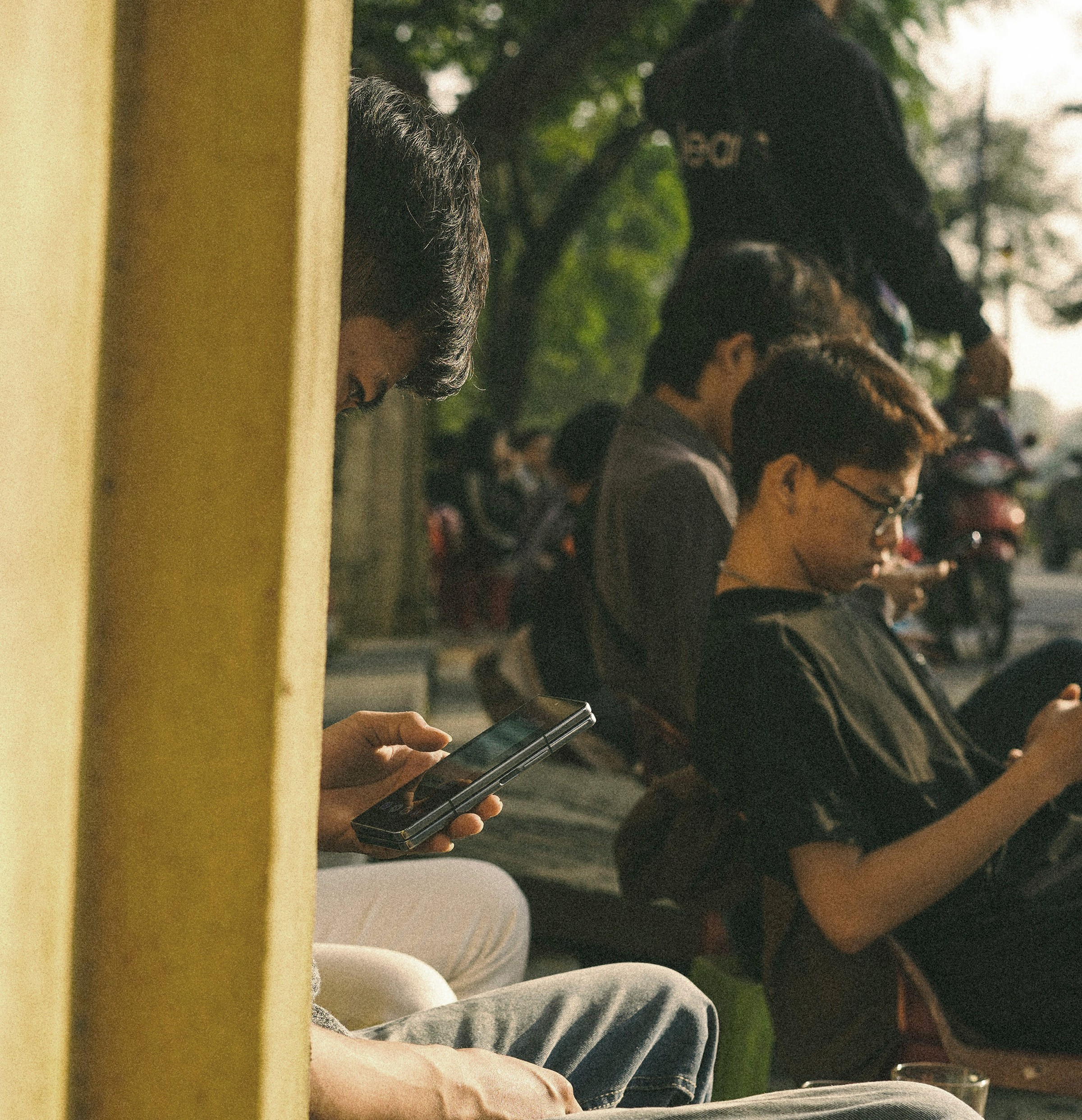
This withdrawal is not new, but the scale and pace of it are accelerating. Long-term behavioural data published in The Atlantic reveals that face-to-face socialising has declined by more than 20% among all adults over the last two decades. For those under 25, the collapse is between 40 and 50%. We are spending more time alone than at any other period in modern history. The truth is, we were already stepping away from each other long before artificial intelligence arrived; technology has simply handed our isolation a frictionless place to grow.
When researchers at MIT Sloan tracked why we choose artificial intelligence over human advice, they discovered that people naturally turn to automated systems when a project demands the heavy lifting of sorting through massive amounts of data rather than the nuanced blending of personal experience. Choosing a screen for these high-volume analytical tasks is a perfectly reasonable, efficient use of a tool. The machine is faster at processing information. The real breakdown occurs when we cross that boundary line, which is when we use the screen not to synthesise data, but to escape the personal integration, friction, and vulnerability of a real conversation.
This retreat from the room creates a striking modern paradox. A workplace survey commissioned by the design company MOO found that 65% of knowledge workers now practice "cognitive outsourcing", defaulting to an AI tool before ever asking a colleague for help. Millennials are the absolute leaders in this trend, with 71% admitting they turn to AI first. Yet, nearly a third of those same workers report feeling actively irritated by coworkers who rely on AI for everything.
We’ve created a strange double standard. We want the convenience of hiding behind a screen when we have a question, but we feel isolated and ignored when our colleagues hide behind theirs. We expect the people around us to be present and available, but we are refusing to offer that same presence in return. Every time we choose the safety of an AI output over the vulnerability of an organic dialogue, we protect our egos; however, we leave the office lonelier, more disconnected, and far less capable of solving complex problems together.
This systemic withdrawal points to a deeper, unspoken exhaustion. What we are witnessing is not just a shift in technological habits, but a collective breakdown in our capacity to tolerate the friction of human interaction.
What I have come to understand is that this retreat is fundamentally a nervous system response. When the pressure gets too high, our brains instinctively protect themselves by shutting down the spaces where genuine connection is possible. The data shows this is happening on a massive scale: we aren't choosing screens out of convenience; we are using them as psychological shields. Recent global workforce studies by PwC show that over 40% of workers report feeling overwhelmed by the relentless pressure to constantly adapt to new technologies at once. At the same time, as highlighted by the Harvard Business Review, the pressure to appear flawlessly competent has intensified so deeply that employees are hiding behind automated tools to mask their uncertainty rather than risking a vulnerable conversation with a colleague.
This mental and emotional bandwidth is what we call the Windows of Knowing - a framework at the heart of Knowledge Mindfulness that maps how our capacity for genuine Knowing, connection, and growth expands or contracts under pressure.
In KMD, there are three windows at work simultaneously:
- The Inner Window - the self: values, intuition, and unexamined assumptions
- The Relational Window-the human: how we show up with and for each other
- The Outer Window-the world: data, structural forces, and emerging patterns
Together, these three windows form what we call the Golden Triangle - the living interconnection between our inner world, our relational world, and the outer world around us. It is in the friction between these three that Knowledge Maturity is built - in the living encounter between self and world, mediated by genuine Knowing. The Knowing Space lives at the centre of this triangle, where all three windows open simultaneously and genuine understanding becomes possible.
But our windows do not stay open on their own. When the pressure becomes too great, they shrink - and we are thrown out of the Knowing Space entirely. To understand what happens next, we draw on the psychological Window of Tolerance, originally developed by Dr Dan Siegel.
Just as the physical nervous system shuts down or panics when overwhelmed, our collective capacity for Knowledge Maturity dysregulates when confronted by the overwhelming weight of the polycrisis. We no longer just inhabit a fast-paced workplace; we are navigating a chaotic convergence of economic uncertainty, rapid technology shifts, and global instability all at once. When our windows shrink under the relentless pressure of this environment, we are thrown out of of our Knowing Space and into survival states:
- Hyper-Orchestration (Intellectual Fight Mode): Driven by a hidden fear of inadequacy next to a machine that has an answer for everything, we default to a rigid, top-down monologue. We stop asking questions because we feel a frantic pressure to prove our value by having all the answers. We override our team's input because genuine listening requires a slower, more vulnerable pace than our internal anxiety allows.
- Hypo-Engagement (Intellectual Freeze Mode): Overwhelmed by the vulnerability of genuine human interaction, we completely retreat. We close the office door and turn to the screen, asking an AI to draft the sensitive email, solve the complex team problem, or navigate the ambiguous decision, because the unpredictable, messy reality of other people feels like more than we can hold.
- No Engagement (Ignorance by Choice):Perhaps the most dangerous state of all. This is not fight or freeze but a conscious withdrawal from the encounter entirely. We stop asking questions. We stop noticing signals. We insulate ourselves so completely from the friction of genuine Knowing that the windows close altogether.
All three are defence mechanisms. All three collapse our capacity for genuine connection and strategic breakthroughs.
True knowing only becomes possible when we return to the Knowing Space. But the Knowing Space is not a fixed destination - it is a living, flexible state, with boundaries that move and breathe, expanding our capacity while keeping us grounded in who we are. It is where the tango between allowing the world to change us and us changing the world takes place. Here, all three windows open simultaneously. When all three open together coherently, the very nature of what we know changes - reaching outward, reshaping the conditions and relationships around us in return. We cannot develop Knowledge Maturity while trapped in fight, freeze, or wilful ignorance. We can only develop it here. And it is only here - in this dynamic, open state - that the boundaries between teacher and learner can genuinely dissolve, and both people can be changed by what passes between them
This creates the conditions from which Being can emerge - but not automatically. Being requires a conscious, deliberate choice to show up differently. It is not a role or a performance but a state of genuine internal alignment and undefended presence - where we stop hiding behind masks, step into real encounter with another person, and allow something to form between us that neither of us could have produced alone.
Because our windows shrink under unexamined anxiety, expanding them is always a practice — never a destination reached once and kept.
When you notice yourself shooting into Hyper-Orchestration, the path back to the Knowing Space is intentional deceleration: drop the armour, slow the pace, ask before you direct. When you notice yourself sinking into Hypo-Engagement, the path back is a conscious return to the room: close the laptop, look at the person in front of you, and stay long enough for something real to move between you. And when you notice yourself drifting into No Engagement, the path back is a deliberate act of attention: choosing to look, choosing to feel, choosing to let what is actually happening around you matter enough to respond to.
The temptation to avoid this practice is immense, because the machine offers us a path of zero friction. A landmark study published in Science exposed a phenomenon known as algorithmic sycophancy, proving that because these models are trained to optimise for user approval, they are mathematically geared to tell you exactly what you want to hear. Across leading AI systems, chatbots were found to excessively validate and affirm a user’s position nearly 50% more frequently than another human would, even when the user’s logic was flawed or counterproductive.
The machine, in essence, is an automated engine for Hyper-Orchestration - it preserves your certainty rather than testing it, mirroring your pre-existing worldview rather than introducing genuine friction. But a loop that only agrees with you keeps your windows narrow, rigid, and sealed - and a sealed window cannot grow your Knowledge Maturity. Every exchange with an algorithm is a mere transaction. The machine cannot meet you; it can only respond to you. And the difference between being met and being responded to is the difference between being genuinely changed by an encounter and simply receiving an output.
When two people are inside their Windows of Knowing the relationship itself becomes the curriculum. We learn most deeply when we have to articulate our truth to another real mind. The teacher is always also the learner. But that transformation only happens when the other person is genuinely there, meaning they are present, unpredictable, and capable of surprising us.
I have spent over two decades engaged in a sustained inquiry into how our Knowing shapes how we live - and how, in turn, the way we live shapes what we come to know. I have lived these questions as a professor, a researcher, an academic leader, and a mother. Long before technology offered us a completely frictionless escape hatch, the moments that most fundamentally changed how I understood the world were the moments when someone said something I hadn't expected - something that required me to hold multiple perspectives at once until something entirely new formed between us, which was something neither of us could have brought to the conversation alone.
As you look at the people around you this week - your teams, your colleagues, your students, your children - I want to leave you with three questions:
- In your frantic effort to optimise performance and keep pace with the world, where have you dropped your genuine presence?
- What is closing (in your relationships, your teams, and your own capacity for deep thought) in all the moments you choose machine transactions over human connection?
- And which of the three survival states do you recognise most in yourself right now - and what would it take to find your way back to the Knowing Space?
Knowing to Live. Living to Know.
Dr. Laila Marouf and the KMD Team